
How to Choose Jade Jewelry: A Step-by-Step Guide
How to Choose
Jade Jewelry
in 5 Steps
Choosing jade jewelry comes down to five checks: stone type (jadeite vs nephrite), quality grade (color, translucency, texture), treatment status (Type A, B, or C), setting material, and sourcing verification. Getting these five right means the piece holds its appearance and value for decades.
Most buyers focus on color and price alone. That is not enough — and the difference is not visible at the time of purchase.
What Most Buyers Never Check
The jade market is complex — and deliberately so. The same visual appearance at wildly different price points is common. The difference is almost always treatment grade or mineral type, not seller error.
Most buyers focus on color and price. That is not enough. A beautiful piece of jade that looks identical to a fine piece at a fraction of the cost is probably Type B or Type C — treated to appear better than it is. It will look different in five years. A fine piece will not.
These five steps are what TEASES evaluates for every jade piece before it becomes part of our collection. They are the same five things you should check before you buy anything.
The good news: once you know these five criteria, every jade purchase becomes straightforward. You will know exactly what questions to ask, what documentation to request, and what warning signs to walk away from.
TEASES was built on this framework. Every jade piece in our collection is natural jadeite (Type A), hand-selected for color, translucency, and texture, set in hallmarked solid gold with open-back construction. We can document everything. Any reputable seller should be able to do the same.
Start with Step 1. The rest follows.
What Is Jade? Jadeite vs Nephrite
Jade is not a single mineral. This surprises most buyers — and it is the first thing to understand before evaluating any piece. The term "jade" refers to two completely different minerals that are sold interchangeably, despite having distinct compositions, characteristics, and market values.
Jadeite is the rarer variety, primarily sourced from Myanmar (Burma). It is harder (6.5–7 on the Mohs scale), available in a wider color range — including imperial green, lavender, white, and yellow — and commands significantly higher prices at equivalent quality. The finest jadeite, known as "imperial jade," is among the most valuable gemstones in the world. This is the mineral TEASES uses in all jade pieces.
Nephrite is more abundant and found across China, Russia, New Zealand, and Canada. It is slightly softer but extraordinarily tough — more resistant to breaking than jadeite due to its fibrous structure. It typically appears in darker greens and creams. It is less expensive at equivalent size and more commonly used in carvings and traditional objects.
Both are genuine jade. Neither is fake. But they are not the same — and any buyer's guide that does not make this distinction clear is incomplete.
5 Steps to Choosing the Right Jade Piece
Choose Jadeite, Not Nephrite — for Fine Jewelry
Two minerals are sold as "jade." They are not interchangeable.
Evaluate Color, Translucency, and Texture — in That Order
Three factors determine jade quality. The GIA lists them in this order of importance:
Always Ask for Type A — Never Assume
Treatment status is the most important thing most buyers never ask about. The difference between Type A and Type C can be invisible at time of purchase — and only apparent years later.
Solid Gold Only — Open-Back, Bezel Preferred
The setting determines how long the piece lasts and how well the stone is protected. Four rules:
Verify the Seller Before You Verify the Stone
The final step is confirming that the seller can stand behind everything above. Four things to check:
How to Tell If Jade Is Real
Most imitation jade passes a visual inspection. Glass, dyed quartz, serpentine, and resin composites can all look convincing — especially in photographs. These four tests help narrow the field before you commit to a purchase.
None of these tests replace professional certification. They are preliminary checks only.
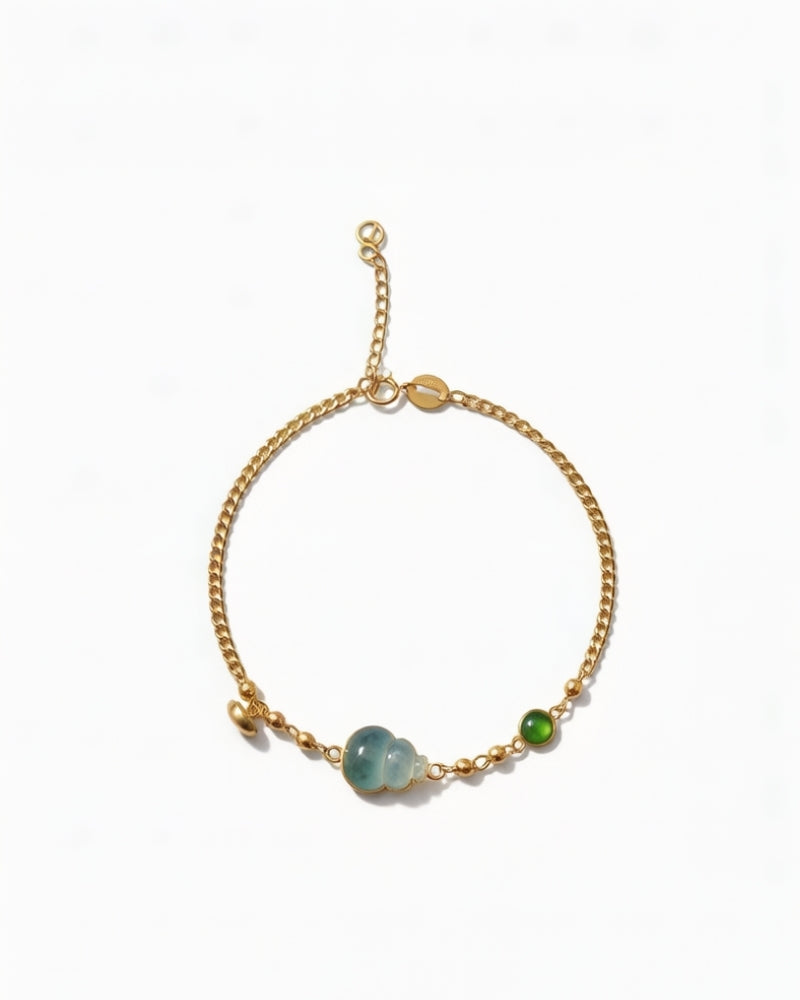
Jade Ingot & Gourd
Gold Bracelet
Knowing how to choose jade is one thing. Finding jade that was chosen this way is another.
Every TEASES jade piece begins with hand-selected natural jadeite — Type A, untreated, evaluated for color consistency, translucency, and grain before it ever meets gold. The setting is always solid 14K or 18K, hallmarked, and open-back. The two-year warranty is not a promise. It is a consequence of how the piece was made.
Worn daily, kept close, never taken off. That is the test a piece has to pass before we make it.
Shop the Bracelet — $349Is Jade Jewelry Worth Buying?
Durability
Jadeite rates 6.5–7 on the Mohs hardness scale — harder than most gemstones worn daily. Solid 18K gold settings do not fade, tarnish, or require replating. A well-made jade piece in solid gold requires no special maintenance and can outlast most fine jewelry in your collection.
Value
Natural Type A jadeite has appreciated consistently alongside global demand — particularly at the fine and mid-tier levels. Unlike fashion jewelry, it does not depreciate as trends change. At TEASES' $300–$600 price point, you are buying genuine untreated jadeite in solid gold — not a seasonal accessory.
Meaning
Jade is one of the few gemstones that becomes more personally meaningful the longer it is worn. Associated with protection, abundance, and harmony across 5,000 years of Eastern tradition, it carries a significance that diamonds and other gemstones do not replicate. You are not buying a fashion choice. You are buying a companion.
Frequently Asked
The five most common questions from first-time jade buyers — answered directly.
Share